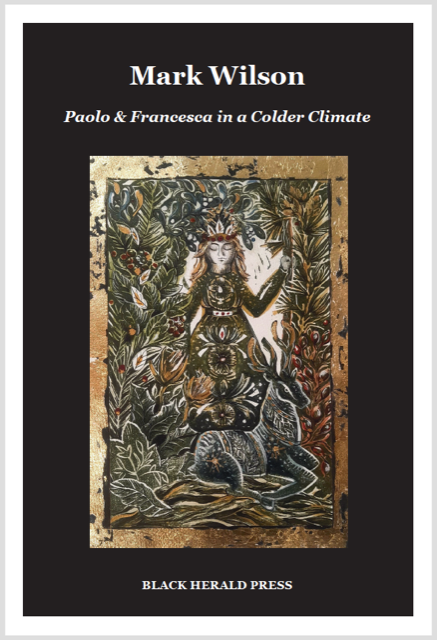
 My first thought was to dig out my copies of Mark Wilson’s other books in order to complete this review… but given I’ve just moved and most of my belongings are still in boxes it may be better to stick to the book in front of me, and simply trade on a little of the memory I have of the previous books. First off; I like this book immensely. What strikes one first is that it is a book of immense grief but also of an immense piety, of a sort not conventionally religious of course. I notice a conversion of sorts with this text… but it does not concern anything of churchianity or historicism in any predictable manner… there is an immense shearing away – in the psyche of this writer – of unnecessary verbiage, but also unnecessary socio-political chatter, an attempt to balance microcosm and macrocosm without the doomery that much of our 21st Century tekne has engendered in us over the last few years… such is only background though. I am not speaking of the language employed or the formal concerns of the lines; the infrastructures of the poems etc… I am speaking of the quality of attention that is steering them. And, that one also notices something of an urge to simplicity and simple statement, particularly in the latter half of the book.
Wilson can turn a phrase, most definitely. His idiom has always borrowed – sometimes quite liberally – from Ezra Pound and Geoffrey Hill. But here, although these guides are still with us, there is also something of a shift away from the 20th Century (do I make the assumption that most – or all – of the poets of our generation still speak ‘out of the 20th Century’, to some degree? I know I do, often unbeknownst to myself…) and more towards the 19th century, and the centuries of Dante Alighieri, along with his immediate precursors the troubadours; the 13th and 14th centuries. Every poet gravitates towards their own Elysium – or paradiso terrestre; – historic, fantastic or imaginery… and, at least for this century, being in its kind of late stage Huxleyan Sovietism, it would be difficult for any poet even vaguely socially aware to NOT offer up something of antidote in that direction. But there is no hard sell, here (perhaps there was more sell in that direction across previous books…?) We are also really in the emotional territory of ‘result’, of what has occurred – diarywise – over the last few years on a personal level, but also what strands can also be picked up from the 80s and 90s on that same personal level.
Firstly, roughly a third of all the poems in the book are explicitly mourning the dead in some form or fashion, and it would not be unsound to say that many others paint in this same hue… of the comprehension of the deaths of other, either in the recent past, or earlier. And I want to state how ultimately revolutionary this simple probably unconscious focus is, in terms of poetry… it will be hard to express this without running the risk of repeating myself from other reviews of Wilson’s work at The Fiend. The word ‘redemption’ was probably used. Well, let’s start there. What needs to be said when it comes to British poetry is that we do not have a record given in the form of poetry of an actual historical or emotional reality for the past half century or more. Why? Because the poetic record, as it were, has been so hampered with formal experimentalism, multiculturalism, and overly intellectual point-scoring, in-group fighting etc, that I wonder if we could even look to poets in Britain as ‘the antennae of the race’ etc. The poet both responds to THE world, and by that response, inhabits A world… and thereby hopes that this interaction is imaginatively OF USE for later generations. One must then have a deep responsibility to get the facts of what is occurring in the macrocosm of events correct, and to see how these interact with that regional world outside of his door… to perceive the correct correspondences between the two… if the voices of the poems become too private (Stevens?) then the risk is that their referents lose materiality for the reader… if they become submerged in the macro (Pound’s risk, even?) then psychological despair and political reactionism – or doctrinaire moods of pamphleteering? – may result. Which is another way of saying that we generally ‘know what is happening’, communally… but DO need to know what is happening to the poet, and the more unique and transcendant their process is, the more compelling their speech will be.
What attracts me to much of this writing is its will to philosophise in the poem itself… to balance abstraction with uncomplicated inner but proto-public monologue (these approaches must merge to give an even vaguely robust modus operandi). The assertion of an audience in the poetic voice – I am beginning to believe – is not to be romantically shunned, or simply arrogantly assumed, it is a privilege to be embraced. To ‘set oneself before another’ to paraphrase Blake:
‘A nation or culture creates
its own divinities, or else it
gets crash-landed […];
One is reminded of Gregory Corso’s picking out the Gods of American pseudo-culture in a poem at mid-20th Century (it was satire, of course, although I’ve cooled a little on Corso myself…)
In ‘Seeing Paul Nash at Tate Britain’ comes the follow-up line; ‘You’d seen / enough of air raids, transportation in a cockpit / of immeasurable brush colour […]’ and there are other lines across poems in this book where we really see – possibly for the first time? – a real urge to place the experience of this generation more solidly in comparison with other previous generations on an ethical level. We live in strange times… we experience no ‘World War’ and yet see our countries economically destroyed by the same powers that the magazine The Fiend was attempting to understand 10 or 15 years ago. We ARE in a war… it has simply abandoned the rules of previous wars… it is technological, it is online ideas, online ruses and deceptions, it is poverty, malfeasance in the highest… and the results are seen everywhere. In some ways we yearn for the second world war… because it is – by virtue of being ‘Past’ – more comprehensible than the previous decade…? But also implying communal duty which has been effaced from social relations and can only be resurrected by explicit political rhetoric
‘Helen’s currently in high definition,
all her hermetic traces are occluded
by the airbrush’s scythe’
Wilson opines in ‘Mythopoeia’; again, this sense of tekne on the rampage, extracting the human element from the picture. It is poems like this that reassure us of Wilson’s acute awareness of the interaction between history and myth. History – in its positive sense – charged with human energy… and heightened, by poetic rhetoric, to the height of myth… but also fragile to the mode of journalistic deception etc. Strange that, in 2026 (as in 1993?) that the British experience – no matter of the form of technocracy; televisual, smartphone, internet – is still predominantly fugitive and fringe. Wilson doesn’t shrug from this reality…
‘Music / degenerates into harsher
rasps, but the crucified
embalm themselves in
the finest traditions […]’ (‘Cemetery Notebook’)
The religious metaphor, shorn of its Christian context, becomes profoundly social and judgemental… a thing we have always known, perhaps, but require being explicitly reminded of. Wilson has always dwelt on the lives of poets explicitly as symbols of the regeneration of cultures, and this collection is no different.
‘Indifferent to the yapping Zeit-
geist, they dig into life-giving
soil, fructify tradition with a
seasoned zest.’
he says (in ‘Poets, Age Forty Seven’)… I’ve sympathy with that here, but I DO see tragedy, in cognisance of the fact that the poem has, in a way, its ghost companion, perhaps suggesting to me (not actually for any personal reason on the part of the poet) that this generation is perhaps more death-weary, more embittered as a result, perhaps than other generations? Do I get the sense that the boomer generation carried at least a semblance of genuine representation in the forms of media open to it… in the ones coming after we witness either such acute fragmentation that no poet (even one conscious of a tradition, with a sound background of study behind them…) or simply no cultural will to esteem them… what we get instead is a yawping silence in the post-boomer world. No actual poetry at all… and, everywhere, the will towards filling the void with total shite in order to plug the gap… we MUST have culture… but it mustn’t say anything philosophically or conspiratorially challenging whatsoever… and this generation (late forties, early fifties…?) lives in the direct shadow of that process, doesn’t it? Anyway, this poem engenders such questions and ruminations in me. It is a ‘silent generation’ in a manner we have never come across before… not because of anything it has or has not done… but because it is the true witness of the 21st Century west. Because of what it has seen, and cannot put the genie back in the bottle.
The spirit of the human being immortal (ghostly or otherwise) seems always in Wilson’s assumptions when writing poetry, however, and becomes something of a theme in this collection. In the material world, however, the struggle of such witnessing is a constant, as in:
‘Most days it’s a miracle to write
& read within this necro-garden,
partaking in your democracy
of the dead […]’ (again, from ‘Cemetery Notebook’)
It would also be hard not to comment on the poem ‘Sectioned’ which comes around the halfway mark, and brings to us a vision of the poet’s mental collapse. It is a poem that is quite different from Wilson’s other pieces, in that the will to neologism is more intensely fractured, more hyperactive… and, in an opposite way? more formal or traditional (16 long lines of fairly similar metrical count)… the voice seeming utterly enslaved to outward sensation (thus the imagistic intensity?) and ungrounded; an ultimate proof of self-confrontation in extremis?
‘Lazarus- / seawildered, staggering out of antiseptic kinema-doors
conscious only of a fulti-framed sweetholymarie
vision, absolutely lantern-elided & unleathered; who,
in the oapposite mirror, is that alien shaven-headed?
Finally – since I have also quoted it enough – it would be worth commenting on this ‘Cemetery Notebook’ poem-in-sequence, and also two ekphrastic poems which mark the death of the poet’s partner. For me, these are the strongest pieces in a very strong collection of poems. It is actually the sequence that really sent me back through the book to read it through again. It has the effect of bringing into clarity the denser sections from earlier poems, and tonally may be something of a departure from Wilson’s earlier books… I think music is the key element somehow. The will to simplicity – but crucially the heart’s simplicity? – that makes it different for Wilson, and also very different from a lot of poetry out there right now. The dead of the dedications at the beginning of the book are now present in the sequence, and we are brought into dialogue with their spiritual attentions through the poet’s machinations:
‘You two in that heavenly charabanc
surveying Camelot vistas are, in
a real sense, out of the ruck of this
ruptured civilisation […] Sunlight’s
dappling through foliage there as
it did in the park at the bottom
of Thorpe Lea Road some time deep
in the early nineteen eighties […]’
This is perhaps the first very explicitly retrospective or elegiac note… or at least more simply expresses that same urge if it has occurred earlier in the collection. As mentioned earlier, there is a quiet thematic gathering of times and epochs here, seeing the poet ranging over Rossetti and Dante to more straightforward early memory. Sections like these refreshingly balance out the sometimes frantic styles inherent in the way Wilson has worked up until now… and it also solves something of a question I had had about modernism more generally… that the will to simplicity is not easily exemplified in those early twentieth century writings… it is a place where creative self-definition truly occurs and is not usually practiced by younger poets. Joyce, Cummings or even Olson do not solve it. They complicate it… and figures like Heaney (even if his influence was truly viable…?) seem uncharged and somehow without substance, perhaps because of there being less philosophical (would it be hard to coalesce a poet so in debt to someone like Cavalcanti with any modern figure in this issue of simplicity of statement?) No, much of the substance of ‘Cemetery Notebook’ is, as I say, unique to Wilson’s work, and unique to 21st century British poetry… let us call that a very hard-won sincerity, in the very least, at least within the confines of a fairly short review.
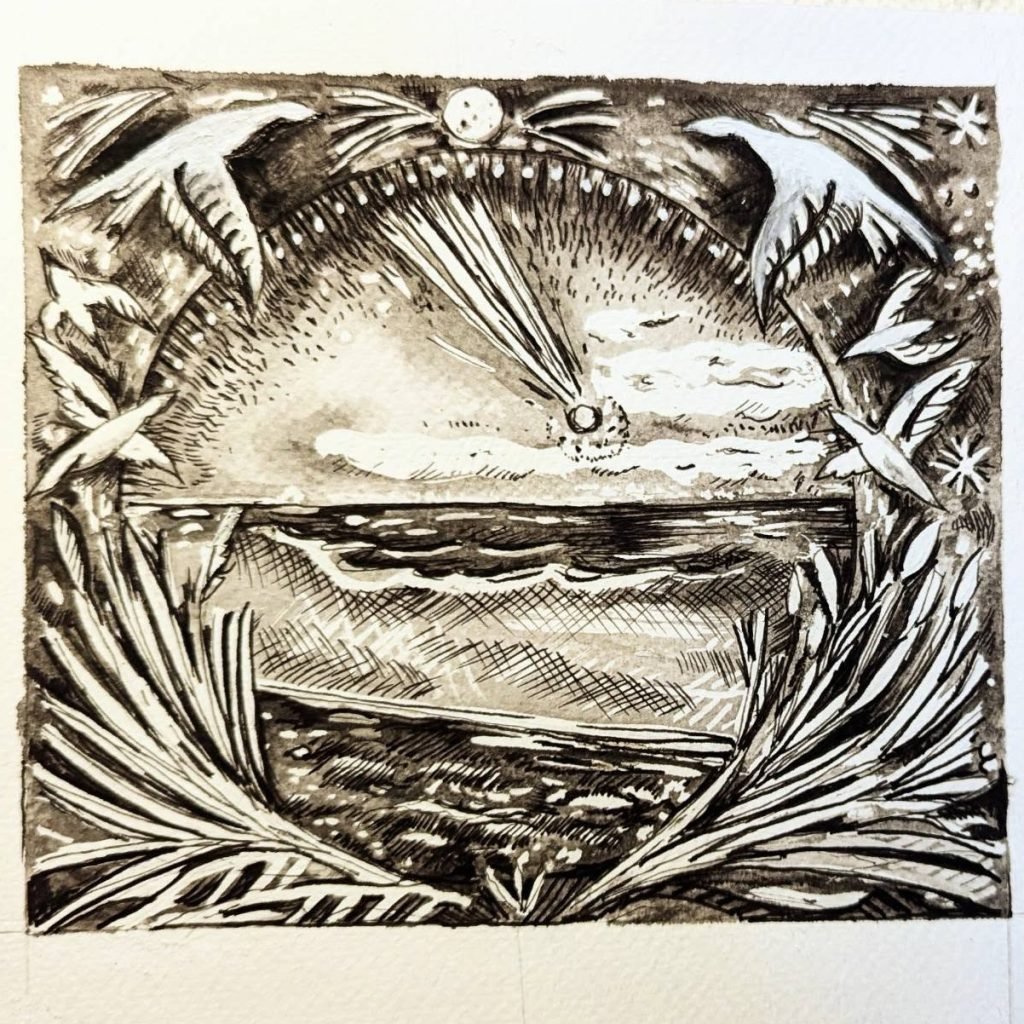
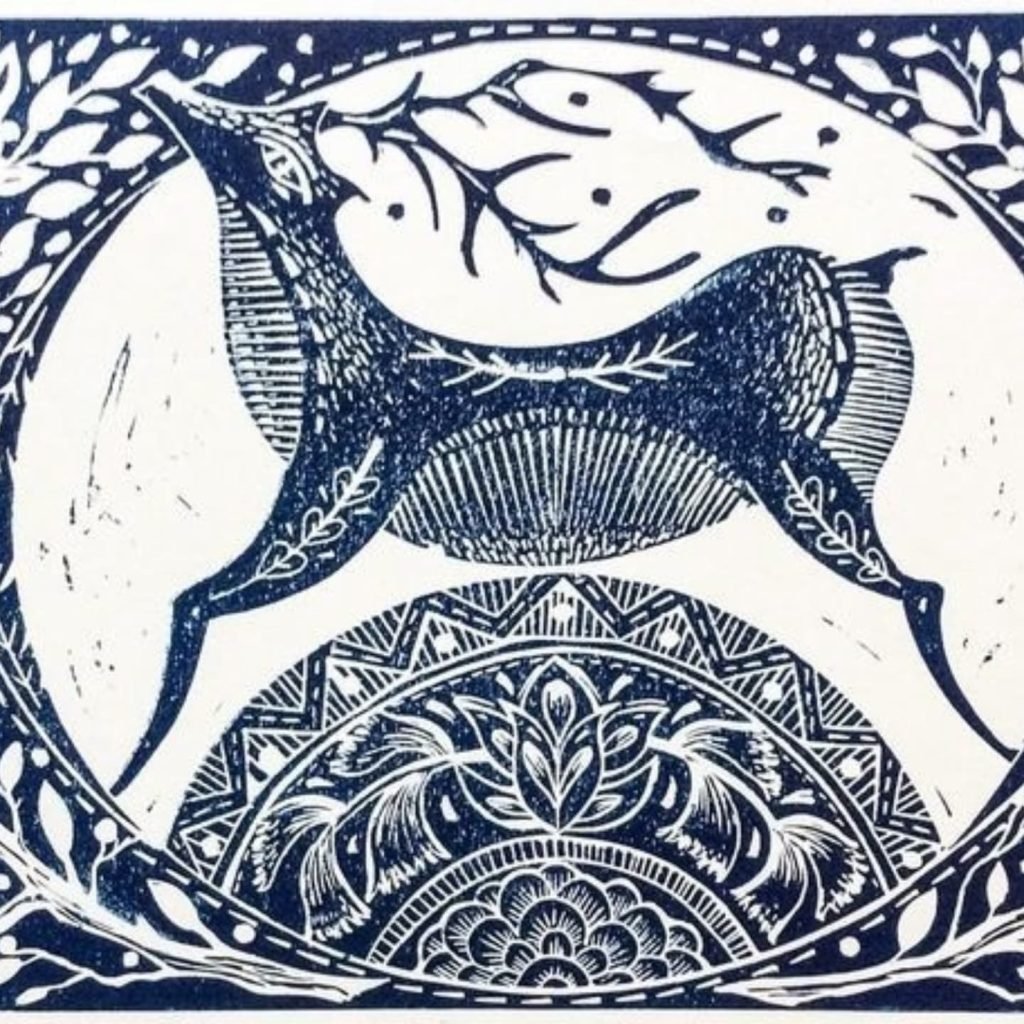
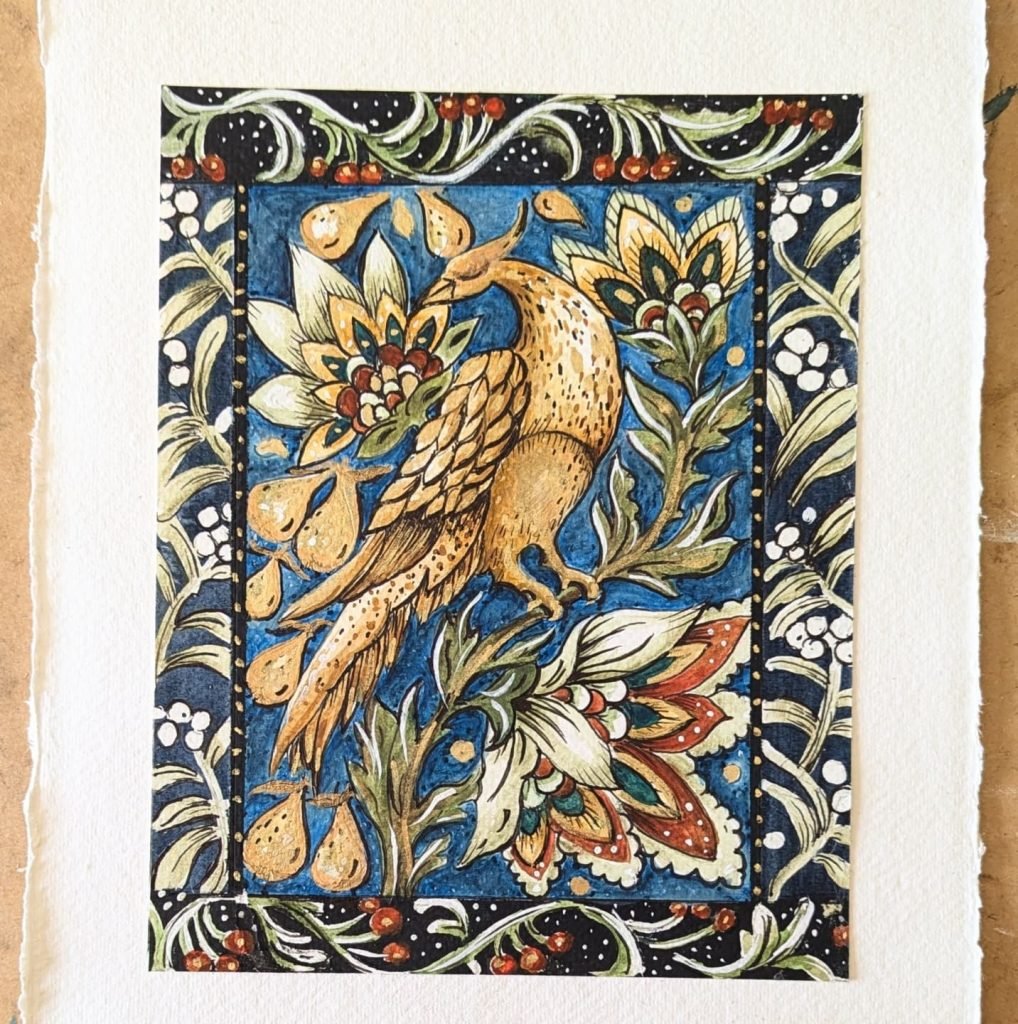
And then there is the, heretofore unmentioned, brilliant interaction between the pictured monochrome pictures (woodcut-esque?) scattered throughout the book (and made by the poet’s partner Amanda Colville) and the poems addressing both her, in absentia, and these expertly-achieved artworks. In some ways it is no surprise, given earlier collections, that ekphrasis is once again part of Wilson’s zone of interest, but this time, for personal reasons, the ekphrastic pieces supply an added poignancy.
‘[…] your hazel eyes
& adept fingers did not flinch
from the undertaking, to re-enact
the soaring sphere of pent flame.’ (‘Comet Over Snettisham Beach’)
The artwork, unlike that earlier emphasis, is now caught in the act, as it were, of being made, acutely and presently. An extra dose of humanity enters because of the heart’s stolid connection. I also liked the lightness and plenitude of this line;
‘And how fast that tide came in,
The Wash surging towards us;
uncanny how naiads do their work […]’
which, risking Pre-Raphaelite overload, also provides valuable antithesis to something in the manner of Larkin’s mid-century miserablisms when it came to his commenting on immediate human connections etc. In fact, it does make one wonder if the early modernist’s swing AWAY from decadent poetry (an over-emotionalising?) strangely ended up with the mid-century inability to maturely vocalise complications and vicissitudes of human connection AS VALUE. I guess what I’m saying is the proper lyric sensibility that all of Pound’s early sources originally asserted IN REPLACEMENT for decadence seems to have been squashed (perhaps because of what happened politically?) or ‘out of the poetic manner’ by mid-century. Here, we return to it, while still ostensibly reading a poem that is in a state of mourning (grief being life – ‘cept not ALL of it – after all?) If there are more of this quality, the pictures definitely merit a small exhibition, or the publishing of perhaps a short run colour picture book. One can see, instantly, why the poet prizes them so.
I very much enjoyed reading this book of poems. I have probably read no book of poems from the last few decades for a number of years, and am surprised and happy that there are people like Mark Wilson who can still produce the real sustaining magic of earlier decades in British poetry, while not shunning the often horrific social and political problems of the recent. More power to him, then, for this force which is philosophic, analytic, vital, lyrical, and very potently his own.
February 6th 2026